Tuesday, August 6, 2013

Chat with Rajeev Kumar

Transcribed by: Sunayana Kachroo

Gauri : Welcome to the foundations Tv. Our guest is Rajeev Kumar who is the founding member of an organization Snehalaya , which has been working for few decades for women and children  in distress
My interaction with Rajeev was at Meena Sundarama’s house when we met for the first time during a meeting for Sahab Bibi aur Guru Dutt. Before I even Welcome Rajiv, I have to say that one of the things that he did really well there was the way he presented Snehlaya to us. He captivated the audience and it almost felt like a conversation with each one of us. He walked us though the growth of the organization, how it was founded, and how well it has evolved. I think it is such an interesting story.
While I welcome you to foundations TV, that’s what I would like to start with. I would love to hear from you about Snehalaya. I would like to know why was it started , when was it started and where is it today.
Rajeev:  Thank You Gauri ,first of all I thank you for giving me an opportunity to be here at Foundations studio. You guys are doing an amazing job.  As far as Snehalaya goes , it goes back to 1989, when a school going kid Girish Kulkarni had the desire to do something for the children of commercial sex workers. He had his own inspiration, he had his own vision about it . We were a group of friends who met with him and Snehalaya was born in his house and his heart. We started working with a few children at Chitragali…which is a red light area in Ahmednagar. The purpose was to break nexus and the cycle in which these children are caught.  These children have been conceived to be either commercial sex workers or to be pimps. That’s why their mothers conceive them. We wanted to break that cycle. It was very hard to penetrate in those red light areas. It took us many months, I would say years  to win the trust and confidence of the mothers of the pimps and goons and of the gurus and underworlds who operate from red light areas. We were young, I was completing my engineering and Girish was finishing his graduation from college, so I think it was very challenging for us. We never thought that we will be doing so many things. When I look back I don’t think we had a grand vision but I think over period of time, the need made us grow and do different things. So today, when we look back we see Snehalaya as a very powerful force in the society. We have been working for various groups and maybe I can walk you thought some of the key projects if you want. So we started Snehalaya for Children of commercial sex workers. We realized that we were not being able to make a significant difference in their lives by just giving them some interaction and exposure because they ultimately went back home to their mother’s house. So, we thought we will build a home for them. We had no money , we had no land , all we had was a desire. There was one gentle man Mr. Mutha, he was very kind and he said that you guys are young and if you guys do a good job, I will give you more land here is an acre of land. That’s where we started and we got our first bunch  of 6-7 kids in 1997,  in this home. It was constructed in 45,000 Rupees which is like $1000 today  or less than that probably. Then, very soon we started getting children that were HIV positive and we decided that we should create a separate section for HIV infected children and women. So, one of the first hospital or care centre for HIV affected patients was created. Quickly, we saw that a lot of people were calling us that this child is being abused , trafficked,  exploited  and can you do something. So we set up 24/7 help line which is like 911 here in America. Unfortunately, we don’t have something like that in India. So, we started helpline and started rescuing children. It has been an  amazing journey. Today we get almost 200-250 calls , and our people go and rescue them. It is full of action. A lot of our young volunteers want to be part of such projects. Later on It was I think late 2000, when we started getting calls that “we have found a baby in a dumpster, we have found baby at a police station, we have found baby wrapped in a news  paper, 2-4 days old babies. Would you guys come and help?” We didn’t know what to do with them. Then  we decided to set up an adoption centre. You will be glad to know that over 300 children  have been given new set of parents and a family and a home across the world and I have some of those children here in  America. Some are in India and some in other parts of the world. Somewhere in 2004, if I am not wrong, we thought that urbanization is really changing the demographics of the country and too many slums were coming up. In 2020-25 almost 20- 25% of India’s population will be living in slums. So we decided that we should do something in the slums because slums make the real recruitment ground for women who were going in for commercial sex, for pimps, for underworld, for terrorism and for many vices of the society. So, we have now started something called as Balbhavan which operates in 5 different  slums in Ahmednagar and also one in Pune where we groom and take care of the entire family on aspects of education , health ,literacy, then de-addiction, and saving patterns.  We have built some self help groups and vocational training for women. That was Bal-Bhavan.
After Bal Bhavan we have seen that more and more cases of the demand and need for women training,  is coming up. Lot of women want to come out of that trade. So we are focusing on skills and are providing them new skills. I think we have a long way to go. We are trying to create a Himmatgram which is another 20 acres of campus which will be one of its kind. This will be an integrated campus for HIV infected people. Lastly, which was done this year, we have created a platform to help women who have been raped which is called Spraha . We did that launch just few months back where we try to provide counseling, legal help and medical help to women who unfortunately have gone through this trauma.
So that’s the story of Snehalaya . It can go on forever, but I will like to stop here.
Gauri: This is indeed very-very touching. You know, it is very easy listening to success stories but anytime I have heard you before and I am hearing you today, I feel like this is something that is so close to the ground. I have seen some videos of women who gone through so much. It requires a lot of courage and a lot of persistence , dedication and lot of sincerity to believe in a cause like this and to continue to work towards the betterment of women and children. These are areas that most of us would shy away from because we are happy in our lives. We are doing things that keep us happy and getting what we want from our lives and to come out of that mode, to be able to feel how those people might  be feeling and do something about that, I think it is such a touching journey.  So, kudos to you and your team,  definitely for coming where you are today.

Gauri: Rajeev, from what I understand, you have also written a book about Snehalya and its work . Could you tell us a little bit about it .
Rajeev : Yes , we just launched a book titled “Defying Destinies”. It is actually a compilation of all the case studies, of  the rescues that we have done in last 7-8 years, best practices, learnings that we have had, what we did right , and what we didn’t do right. May be, it will be a great guide for other NGO’s who are working in this field. One very interesting judgment is there in that book which was given by high court –to life imprisonment for almost 20 people in trafficking case of two minor girls. Please read it and I would love to give it to you.
Gauri: I would certainly love to read it myself and I would highly recommend it to anyone who is looking to work in an NGO or has any desire to learn from this process. So, how would they get hold of this  book?
Rajeev:  We did not have any publisher. Snehalaya is the publisher. It is on our website and we would love to ship it to you. If you want it, you can send an email to info@snehalaya.org , we will send it you.

Gauri : I have watched the first episode of Satyamay Vijayate which was the TV serial by Aamir khan and the first episode itself was on female feticide and Aamir Khan had endorsed your organization Snehalaya, which is pretty commendable. I want to understand from you, what that endorsement means to you. Of course,  it means a whole lot for someone who is looking into organization but being inside the organization what does it mean to you?
Rajeev: Very good question. I will say that it was really a turning point for Snehalaya, being endorsed by Satyamay ViJayate. For almost two decades we have been working in this area and Aamir khan production team  - Swati Bhatkar  Satyajit Bhatkar, the directors of that program , they identified Snehalaya. Not only that, Aamir and his team visited Snehalaya twice. Our children have been so happy seeing them in the campus. He came with his entire team. They performed for our children and he launched Satyamay Vijayate DVD. On May 1st we had an event, a workshop on Trafficking and Natural Calamity because of the drought condition in Maharashtra. Both Aamir khan and Anna Hazare were there for that workshop. You will be surprised to know every 22 minutes there is woman or a girl child being raped in the world, every 10 minutes there is girl who is being trafficked. Trafficking is the third largest organized crime after drug and weapons and it’s a very serious problem. It is around 800 billion dollar industry and we really want to work and motivate people against human trafficking. So, Satyamay Vijayate and Aamir khan’s endorsement meant a lot to us both financially as well as being known in the society. We are thankful to them.
Gauri: Wonderful and you have also shared some of the pictures with us which are part of this presentation,. We would also put together a powerpoint presentation or a slide show to share with  our audiences all the phenomenal work that has been endorsed by Aamir Khan that you do at Snehalaya.
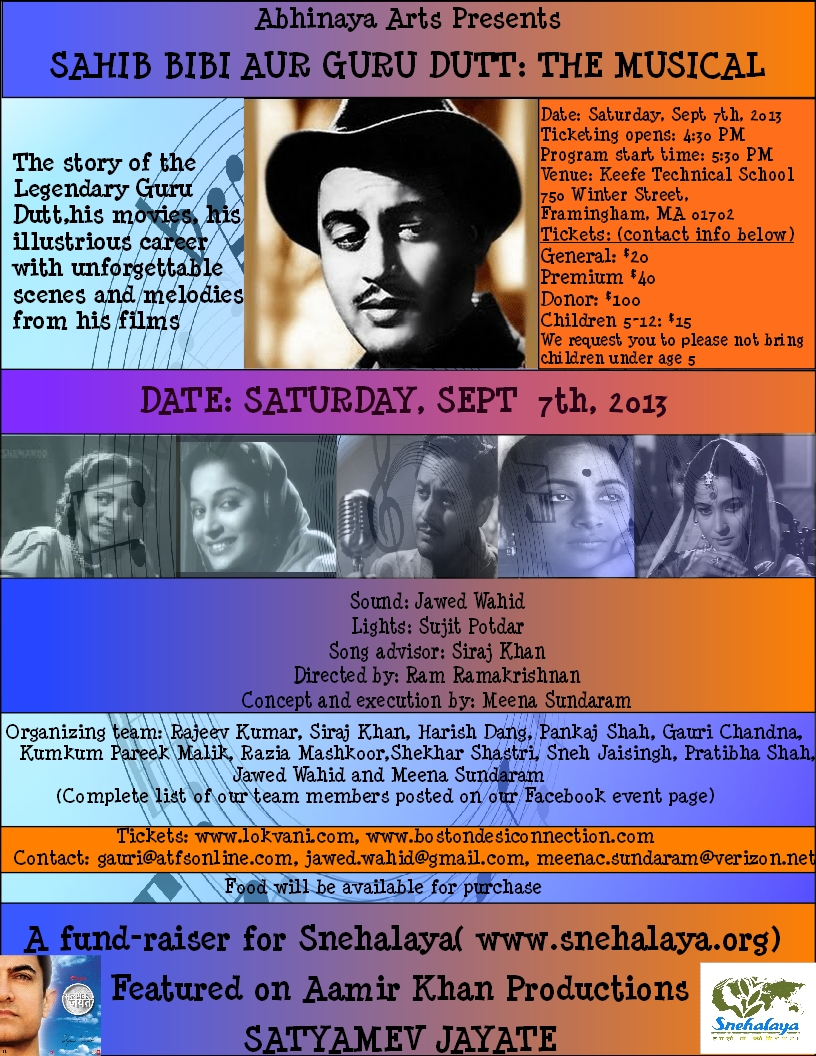
Gauri: Now that we have heard so much about the organization and everybody who has heard this interview feels connected and wants to contribute, somehow towards this organization and towards this cause. I would like to share with everybody that one way to do that is by coming to the Sahib Bibi Aur Guru Dutt show , a musical evening which is being  organized on Sep 7th , which is actually a fund raiser for this wonderful organization run by extremely sincere people. We can all be very assured that this cause is a genuine cause. We can be assured that the efforts that the team of Sahib Bibi Aur Guru Dutt are putting , all those efforts are going to go towards this cause. We are all very excited actually and it adds to the excitement of the organizing committee as well. My question to you though is, how does this benefit the organization?
Rajeev: Well, the obvious answer is that it financially benefits the organization but more than that you may look towards these events as an embracement of our team ,our work and we feel that more and more people are part of Snehalaya family. I would welcome all the people who are coming for that event to Snehalaya. If you are coming to India, please visit Snehalaya at Ahmednagar. It is around 180 kms from Mumbai. We would love to have you there. Our children would love to have you there. We run a radio that is Snehalaya radio. It is an FM channel. We would love to play that event for our children and for people there at Ahmednagar to show how much love and affection we are getting in Boston. Thank you to Meena Sundaram , to you and to the entire team. It is a very big team that’s trying to put together this show. Thank you very much.

Gauri: Thank you so much . That really makes us feel very special. All the effort becomes really really authentic by listening to everything that you have shared with us today . So, thank you so much for coming and I would personally like to wish you good luck. I know after spending 10 years in this country, you are moving back to India only for this cause and your dedication towards this cause. We are very proud of you as a community and we wish you all the very best from The Foundations TV.

Wednesday, July 31, 2013

chat with Jawed Wahid

Gauri: Foundations TV is extremely excited tonight to be actually coming out of our own studio and visiting a different studio. If you’ve ever organized an event or even participated in an event in the New England area, you’ve already probably visited this studio. Our guest tonight is Mr Jawed Wahid. Welcome.
Jawed:  My pleasure. I enjoy being here. (smiling) It is my place.
Gauri: Of course. So as you can see, we’ve managed to bring him in front of the camera. He is barely ever seen in the front. He is not only the back bone of all shows, he is also a perfectionist. Most of the times I have seen hi tweaking the ports and knobs, trying to fine tune the sound for hours at a stretch just to make sure that the sound for every event is just right, just the way he would like to hear it. He is a very very dedicated person.
Jawed: It is a lot of work
Gauri: Absolutely it is a lot of work. It requires a lot of dedication and passion to be doing something like this.
Jawed: It is a labor of love

Gauri: I can see that you are in love with music and that actually brings us to our first question. Talking of love for music, I want to understand what was your motivation is dedicating this whole room to musical events? There are not only events that you participate in or help out with as a sound engineer, but you also host a lot of events here in this studio.
Jawed: Music has always been a passion for me. Though I was never formally trained for music as a child, I always found that music stirred something within me, a passion, and tremendous sense of peace. In my opinion, the joy of music is really multiplied as you share with people. I think music is something that should be shared. It is a group activity. Listening to music alone can be interesting but the pleasure comes with sharing. Hence I built this studio so I can share with many people.
Gauri: Excellent. I couldn’t agree more with what you said that the joy of music comes from sharing. It is truly ‘The more the merrier’.

Gauri: So, Jawed ji is not only the most sought after sound engineer in the area, he is also a very compassionate, sensitive and a very respectful human being and I think that is what differentiates him and makes him the most sought after sound engineer for most events here. Tell us a little bit about your evolution into reaching here where everyone wants to involve you in the events.
Jawed: Before getting into sound engineering, I had attended many programs that were disasters due to the poor quality of the sound engineering. It ended up being a waste of time for the audience and for the artists on stage. Those days they used to come from India. There were very few local artists who would perform. So being an electrical engineer with a specialization is signal processing, and naturally analytical being an engineer, I could easily understand what the factors were that were causing the bad sound to happen and I knew what would be necessary to fix the sound. So, I then went about getting top of the line expensive equipment that provided me with the tools that I needed to produce good quality sound. Contrary to what people may think, a mic is not just any mic and a speaker is not just any speaker. A high quality mic and a high quality speakers only would give you  high quality sound. So if you buy cheap mics and cheap speakers, you are actually going to get a very poor sound. And people just don’t seem to understand that fact. So, apart from my engineering background which helped me understand that, I have also extensively read about sound engineering techniques. I read articles on the internet all the time about good mixing techniques and poor mixing techniques. I am constantly learning and incorporating that in my work. So, every event I go to, I do something differently based on what I have learnt. I think life is always about learning and I am always learning sound engineering.
Gauri: Excellent. So, you’ve definitely shared the technical aspects of it that you have to go with the high quality equipment and you have to have a good knowledge about it. But I think there is something else to it which is the magic wand that you hold.
Jawed: (laughing) Yes, there is a little bit of black magic. If you give three people the same ingredients to cook, the output is going to very different. Somebody would produce a very tasty dish and on the other hand another person may produce a disastrous dish. I do agree, there is a ‘black’ art to it.
Gauri: Yes, there is a personal touch and I think you touched about it a little bit that every event you do something slightly different and you keep learning. It is an experience and it is an evolution in itself. It is a process that continues to evolve.

Gauri: So, speaking of events, how soon do you recommend that people contact you if they are trying to organize and event?
Jawed: Actually many event organizers first contact me for my available dates, and check the venue for their available dates and then the pick the dates based on when we are both available at the same time. Basically I get involved when the event is still a concept. If they plan the event and if I am not available, then that could be problem for them.
Gauri: So here’s a cue for everybody who is thinking of organizing and event in this area, get him involved early.

Gauri: Could you please share something about your association with SBAGD, which is coming up on September 7th?
Jawed: Sahib bibi Aur Guru Dutt is being organized by a friend of mine, Meena Sundaram. I have known Meena for about 4 years now ( my memory is kind of bad that way). We were introduced by our common teacher Warren Senders. When Meena was looking to do an event back then, she needed somebody for sound. Warren know I do sound, so he said, ”If you want to do sound, contact Jawed” and that’s how we got to know each other and we’ve been doing programs ever since. So, when Meena said, “I am planning an event based on the life of Guru Dutt”, so I told her that the fact that I am going to do your sound is given, but since this is such an intriguing project, I would like to get involved in something just more than sound. I am now helping out with some of the AV and a lot of the technical infrastructure. When you come to the event, you will see that there are a lot of interesting things happening, that don’t usually happen on a lot of other events. She needs a lot of technical support to make that happen. You’ll find it out when you come to the event.
Gauri: Alright! So looks like we have some surprises put in place for September 7th . this is actually a good time to invite everybody who is listening to save the date for September 7th. I know it is a few months in advance, but this is the time you should reserve that date for an excellent event which has some surprises in it.
Jawed: It is really going to be an interesting program and you’re really going to enjoy the new things we are going to present and the way we are going to present some of the material too.
Gauri: Excellent. Looking forward to it.

Gauri: Working with various people, at different locations, at various auditoriums, with different sound systems, and with all the different set ups, I’m sure there’s a lot of different challenges that you have faced. We would like to hear about those.
Jawed: Well, one of the things that I never do, or very rarely do is use the in house sound system because I don’t know what the quality is going to be like and if there is a problem with it, then I don’t know how to fix it. Whereas, with my own equipment, I know exactly how to manage it, control it , and if there is an issue, I can resolve it. I have been doing a lot of programs in most of these auditoriums, and in some of them, like in Keefe tech, I’ve done many programs. The staff there knows me very well by first name. they are very helpful. They’ll help me unload stuff and help me load stuff at the end of the day. Even if I am a little late, they don’t mind, or even if I stay a little beyond the time. They are usually a friendly bunch. The only real challenge I have is if I go to a new venue, where I’ve never done an event before. The staff invariably is very helpful, so that’s never a problem. I’ve never run into staff that is not helpful but in a new auditorium there is always a challenge of how to optimally lay out my sound equipment i.e. the placement of my mixer, placement of the speakers, how I run the wiring. Most importantly every auditorium has a unique sound profile, and I need to equalize the sound profile for  that auditorium and that takes a little while. For the auditorium that I have already done, I know what the sound profile is and it is easy for me to dial in my mixer for that auditorium. For a new one, it takes me a little longer, but I can manage that. Now I have a lot of high tech tools to help me.
Gauri: So, in two words, he’s the expert.

Gauri: How does it usually take you to set up the sound on the day of the event?
Jawed: Well, that has a two part answer. If it is a new venue where I’ve never set up the sound before then, I will require a site visit sometime ahead of the event. I talk to the event organizer and I meet them there and ask them for the venue technical person to be there. I like to do the site survey ahead of time so that there are no surprises. I like to know where do I load the equipment from. I don’t want to find out that day ,” oh you gotta climb up 4 stairs to get your equipment in”. That’s not gonna work. So, I find out where the loading is going to be from, how far the loading doors are from the stage etc. I need to know that all ahead of time so I can plan accordingly. If it is right next to the auditorium, I can load very fast. If it is at the other end of the school, then you have to walk 10 minutes for each load. So, that’s the first part. The second part is on the actual day of the event. That is dependent on what’s being performed. If it is going to be large group as we did for YJMH, that takes me many hours to do, coz you have to set close to 30 lines. For a small event, with a couple of singers, it can be less. YJMH was 5 – 6 hours spread over two days, including a sound check with the artists. Typically, for a smaller event, 2 – 3 hours should be more than enough to do sound check. I am usually there a minimum of 2 hours before the event, more commonly 3 hours, and another 2 hours after the event cause I have to pack up all my equipment and load up the van. So, I am always the first to arrive and the last to leave.
Gauri: So it’s  really not as easy as it looks. We kind of assume when we go to a good show, we enjoy it and come right out, we take the sound for granted. The sound was excellent as long as it didn’t bother our ears and everything went fine, what we don’t realize is that to create a sound that not only doesn’t bother the ears but actually brings out the beauty of music, there is so much dedication and so much sincerity of work that goes in behind the scenes as well.

Gauri: Speaking of sincerity and dedication and so much hard work, I’m sure there’s a lot of people who are listening to you and looking upto you and thinking…hmmm…what can I do to be where he is today. Can you share some advice/tips for people who are looking to follow your footsteps?
Jawed: First of all I should let everyone know that sound engineering is not for everyone. Contrary to what people believe that it is as easy as turning a couple of mics on, it’s not that simple. Just like thinking if everybody can  be a good cook or everybody can be a good singer. No, you can’t. You might learn the verse of the song, but if you don’t have that vocal quality, you can’t be a good singer. Similarly with sound engineering, you require a knack for understanding of how things work. If you don’t have that knack, don’t try. All you’re going to do is destroy someone’s program. So, no point trying cause that poor person is on stage and you’re giving them optimal sound. But if you feel that you have a knack for sound engineering, then first and foremost, you should invest in good equipment. Don’t cut corners on equipment. The equipment really makes the difference in the quality of the sound coming out. In fact I would say that the quality of sound coming out is directly proportional to the quality of the equipment. There’s no two ways about it. I have cycled through a lot of equipment over the last few years. Every time I find something slightly better, I go for it, even if I get a 3% improvement. People don’t perceive it, but I perceive it. And the second thing is that no one is born with the knowledge of sound engineering, so by all means pursue knowledge. I have read many books, I continue to read books. I go on the internet and I do searches on specific areas of sound where I think there might be a weakness and I find out tips that can help me overcome those weaknesses. So, I am always learning better sound engineering techniques. That’s the only way you’re going to get it. 
Gauri: excellent advice.

Gauri: Since this is an interview conducted by The Foundations TV, our listeners are looking to hear from you what your motivational and inspirational message for our listeners is?
Jawed: You asked the wrong guy that question. The reason is that, if life permits, follow your passion. Live for your passions. They give us true joy and satisfaction. I live for my passions. I am a passionate sound engineer, am a passionate skier. I ski 2 or 3 times a week during the season. I go out west to ski. I follow my passions. I passionate bicycle rider, I am a passionate motor cycle rider, I am a passionate sports car person. And I follow my passions but you have to balance that off with the realities of life. So, you have to make sure that your life is under control and you have over your head. Balance it off but don’t drop your passions. People tend to drop it off very early and they become workaholics. I am on the other side. I am a passion-a-holic and I work just enough to keep my passions going. That’s my advice.
Gauri: This is all surprise to me. I did not even know all the things you do. You live by the words that you believe in and that’s the whole essence of life. To be able to maintain that balance where you do what you need to do but you also are able to find the time to do what you want to do. That is an excellent message for our listeners to take away from this interview. And I am definitely going to walk out thinking what am I going to do tomorrow, is it going to be what I need to do or things that I want to do. So, I’m going to try and balance that out and I’m sure everybody will enjoy this interview as much as we enjoyed doing it. Thank you so much for your time and for hosting us here in your studio.

Jawed: My pleasure and best of luck to you on your new venture The Foundations TV.

Gauri: thank you so much, and on our way out we are actually going to take some of your advice on the sound. 

Thursday, July 11, 2013

Chat with Siraj Khan

Gauri: Hello everyone, Welcome to The Foundations TV. Our guest today is Siraj Khan or should I say, THE Siraj Khan. Having worked with him on various projects for the last year and half, I have not only gotten to know him better as a person, but also observed how inspired and energized others get when he is in the room. At times he may be the most significant voice in a room, directing those around him, suggesting ways of improvising and narrating inspiring anecdotes and at other times he may be sitting quietly in a corner absorbing all talents in a room and figuring out how to unveil the potential of a person or a situation at hand. He is certainly a person who takes genuine interest in the talent display around him and is eager to showcase them through numerous cultural projects that he is personally involved in. And that Siraj Ji brings me to our first question.

Gauri: Welcome to The Foundations TV. Such a pleasure to have you here. You are a well known personality in New England. Most people have seen you either on stage, or back stage managing and directing. I know you have been very active in the community for the last few years, but I would like to trace it a little back to know what was your first ever interaction with the stage? How did you start , evolve and get where you are today.

Siraj: (laughing) You called me a ‘stage personality’. That is so amusing. I am no great stage personality but my association with stage goes back to my school days, singing on stage, participating in various  student dramas. Whenever I was asked to participate in something, I used to jump into it and felt very comfortable. And then through college and growing up , and got married, but I think, if I have to look back, it was music which was what really got me on stage. I was really at my best sharing the music, presenting the best possible to the people and sharing my joys with the others. Music really, I thought,  was the best way to do it.

Gauri: Wonderful. So, this is really nice as I have seen you enjoying music during the shows here in the last one and a half years. Most of the shows that we have worked together on, I have observed you sitting and enjoying the music even during the rehearsals. I can see that is the closest to your heart. So, certainly that is very nice to hear from you as well.

Gauri: Now I would like to hear a little bit more about the shows that you have been involved in recently and what different roles have you played in all these shows that we see your name listed in.

Siraj: Well, something very close to my heart, as most people know, are the O P Nayyar nights that I have been doing since the great man passed away. From 2007 upto last year, every year, religiously, we have been doing this, and it is very moving that so many people have joined this journey with such passion. And then one of my fondest memories is doing the Geeta Dutt show in 2011. It was called Hawaon ke Taraane and it had a black and white theme. Can you imagine 70% of the audience was wearing black and white attire at my request. I mean, it was most incredible. So, I produced and directed that included the entire music and the whole nine yards. Last year Rooh-e-Sahir that I co-produced with Harish Dang and Razia Mashkhoor. I was the creative director for that and that was a huge hit where we projected a poet. Normally it is a music director or a singer. We had Melodies and Memories. I remember Shankar Jai Kishan night with Sharda. I produced and directed that. More recently, we had Madhubala show and you were part of it as well. I was the program manager for Adnan Sami show. So, I was not on stage for that one, but I managed everything back stage. And I have very fond memories of the Din Check show, in which again I was with you. So, the role that I had has been different namely back stage, front stage, creative, music, and I have enjoyed everything that I have done.

Gauri: This is wonderful. Playing different roles is absolutely an enriching experience not just for you, but also for the audiences as they get to see all the different talents that you bring along with you. So, that actually brings us to the next show that you are involved with which is Sahib Bibi aur Guru Dutt and I would love to hear from you what role you are playing in that show.

Siraj: Well, there is a very interesting connection. I remember, I told you about O.P. Nayyar. O.P.Nayyar and Guru Dutt had a very strong connection in all the old movies like Aar Paar, CID, so that came in very naturally. I got at assignment of taking care of the music, the songs, and the sequence, who’s going to sing what, to develop the alignment with the characterization. I would really request the listeners who are watching this show to come and witness this very unusual event. It is brilliant combination of music, literature, acting, all looking at the fantastic personality that Guru Dutt was.

Gauri: That is extremely exciting for everyone I’m sure. Guru Dutt has a lot in his life that we can all get inspired by and this show seems to be coming together really well. With talent such as yours, I think there is no reason for anyone of us to miss that. Looking forward to seeing everybody on September 7th, 2013, at the Keefe tech auditorium, starting at 5:30 p.m. . The tickets are already available on Lokvani as well as Boston Desi Connection. So, please go ahead and buy your tickets. Looking forward to seeing you all there.

Gauri: Lets talk about something really interesting. From what I hear and from what I understand, you have been a traveler and have travelled to over 70 countries. Now that is really intriguing to me. It is well known that the more you travel, the broader the experiences and the more enlightening it gets. I would love to hear about your experiences as a traveler and how that enriched your life.

Siraj: Yes, it is probably now 75 countries. Travel is very fascinating. Reason behind my travel has been work, pleasure, adventure, all combined. My wife Yasmin, also loves to travel. So that always helps. I consider myself to be a world citizen and live a life without boundaries. I think that has been the outcome of all my travel. A lot of people would think that these 70 or so countries are exotic places like Europe and all, but fortunately or unfortunately, I have been into terrible places too, to tough terrains like Sub Sahara Africa, and some of the Asian countries. But every country had a separate experience. Not sure if that answers your question.

Gauri: It does and I would like to go a little deeper here and would like to hear something funny, interesting or once-in-a-life-time kind of experiences. I am sure you have many, but I would love to hear one or two of them.

Siraj: Well, I was working for a company called Path Finder. I was setting up their office in Papua New Guinea interacting with all sorts of people there, including cannibals. Actually even slept one night at a cannibal village. My mother and my wife were praying for my safety, as they thought that the cannibals would consume me. I ended up there in the evening with no telephone, no pure water to drink and stuff like that, and no electricity. So that night, they were doing their own music around the fire, and I was asked to sing and I sang, ‘maang ke saath tumhaara maine maang liya sansaar’ . Now that was the time when Nayyar saab was alive, so when I met him, I told him that I sang his song while I was with cannibals. He just gave me hug. This is what I love about music that it is the only international and global language. Everyone understands that and I have come to be a great believer in that. I tend to do a lot of bridge building through music. I have made more friends through music than through anything else professionally.

Gauri: So three things I gathered while I was listening to you.
1. If I was in your place , I would be so scared sleeping in the same place as the tribal population . I truly would be very uneasy with that . So kudos to you for your bravery.
2. The other thing I would’ve probably loved to do, as you were describing how people were  running around the fire and doing their thing. I wish we had a means of sharing pictures at that time. I would’ve loved to see pictures of that.
Siraj: I do have pictures of that. That is something to be standing next to the cannibals and have a picture taken with them Infact the whole village was there and the chief was there as well.
3. The third thing that immediately struck me was what you said that music has no language and no matter where you are, any song you sing, or any melody that you can create just by being in the moment adds more beauty to the moment.
               Siraj: Absolutely, I couldn’t agree with you more

Gauri: Even though the flow of conversation has been so interesting, and we could go on for ever and ever listening to the stories and anecdotes you have to narrate to all of us, but in the interest of time, I would like to bring ourselves to the last question of this interview. Since we are here at The Foundations TV where our intent is to spread inspiration through awareness, what’s your inspiring message to the listeners of The Foundations TV?

Siraj: Well my message is something that we did not touch during the entire interview, and may be this is a good time to do it, is my passion for education and knowledge. I am not in the academia at all but this has been a great driver for me all along. My message is probably well contained in one of Mark Twain’s quotes “I’ve never let my schooling interfere with my education”. This is what it was all about for me, with all my experiences with tribal and all. It was all about broadening my horizon. Whatever way you choose to do it, there is really no end to seeking knowledge. This is something that I would like to pass onto not only just the kids but even to people older than me because it a very frustrating to see people take up retirement, just having chai, reading newspapers and watching TV. I would rather everyone goes out there and shares their knowledge and experiences that they have acquired.

Gauri: Wonderful message indeed. And my take away from this one and hopefully for the audiences as well is that you never stop learning in your life and you never stop growing in your life and the width of your experiences is what adds to your knowledge. So, definitely continue to widen your sphere, continue to learn whatever you can, and continue to grow in whichever direction your heart takes you. This is what we would like to end at, today. Thanks so much for being here at The Foundations TV


Siraj: Thank you for giving me the opportunity and I wish only the best for The Foundations TV . It is a good start and may it, just like a plant, flourish and cultivate into a big tree.             

Monday, June 3, 2013

Chat with Mr. Warren Senders

Gauri: Our guest today at The Foundations Tv is Mr. Warren Senders who is an internationally recognized vocalist, composer and performer who has studied and rendered Hindustani music for over 30 years. The leader of the indo-jazz ensemble Anti-Gravity, Senders is a member of the New England Conservatory faculty and a Learning Through Music specialist who applies a rich background in Indian, African, and Western music toward cross-cultural aspects of learning through music programs in public elementary schools. Mr. Senders has studied Hindustani vocal music since 1977 and has been performing professionally in India, Europe and America since 1991.
He considers his music journey began with the absorption of sounds that he heard even before he learnt how to speak. As a child, listening to Mozart being played in their home, singing Gilbert and Sullivan, to being impressioned by a guy who would occasionally walk up and down the suburban street playing Scottish tunes on his highland pipes, all ‘musical childhood exposures’ contributed to impacting his musical instinct which has now developed to a level that inspires so many around him. His first ineffective guitar lessons, or his short-lived associations with a garage band, or even his 4th grade teacher telling him that he can’t sing, did not stop him from singing informally at summer camps. He slowly developed a liking for jazz music and fell in love with freedom of it. He believes that this exposure early on helps him take chances with music, in using his imagination and creativity. His next love was Hindustani classical music.  After learning for eight years in Boston under Smt. Kalpana Mazumder, he traveled to India hoping to become a disciple of the renowned Bhimsen Joshi. But despite his love for Joshi’s singing, Senders was dissatisfied, and continued his search for a teacher who would be able to  give him one-on-one lessons to satisfy his passion for learning Hindustani classical music. Once under the supervision of Pandit Shreeram Devasthali, his life took off as a Hindustani classical musician. Of course this involved devoting each and every minute of his life being spent, living and breathing his passion which is music. Staying true to his passion all along, and now decades later, he has numerous writings and recordings to his credit. He is a master mind for various unique musical concerts in the area for the last two years. Each concert focusses on a different aspect of music – voice, percussion, bowed strings, and plucked strings, to name a few. The common theme in all of these being “Playing for the Planet” . And The Foundations TV is honored today to have Mr. Warren Sanders here with us to talk about these concerts.

Gauri: Welcome to The Foundations TV. It’s a pleasure to have you here with us today. We would first like to begin with your association with the environmental causes
Warren: Thank you for having me here Gauri. I am a musician. I am a composer and my association with environmentalism really emerged at the time when my daughter was born in 2005. Watching the news of climate change gradually began to dominate my time. I began thinking about my daughter’s future and I realized that as a musician, I am part of a long human tradition that goes back hundreds of thousands of years, perhaps even to times before there were human beings. We’ve always sung, we’ve always danced. So, to be a musician, and to be as I am a music teacher, means that we are part of a tradition that stretches back to an unimaginably distant past, and if we don’t stretch forward into an unimaginably distant future, then the meaning of our work is diminished. This made me think that musicians needed to be in the forefront in the fight against climate change. This is what lead me to produce the series of benefit concerts and we now have one coming up in June.

Gauri: This is such a beautiful concept. Mr. Senders is doing fantastic work bringing music talent together for environmentalism through the “Playing for the planet” concerts. And that’s what I would like to hear about. How are your concerts helping the planet?
Warren: In 2009, I was involved with environmental blogging on a progressive daily quote website, and I asked one of the other members of that community, what I could do since I was not a climate scientist and he directed me to a website called 350.org. This is run by the environmental writer and activist Bill McKibben, for whom I have enormous respect. The number 350 in ppm denotes the maximum allowable level of Carbon dioxide in the atmosphere. As the climatologist James Hansen said, “Consistent with maintaining our planet in which our civilization evolved, to which all life on this earth is adapted”. We are now at 400 ppm and it’s climbing. That’s not good. The first ‘Playing for the planet concert took place on the ‘International day of climate action’ on October 24th, 2009 and featured 6 different artists. I was one of them singing Indian classical music. The point of these concerts has always been, that we get artists that represent different world traditions and put them on the same stage, one after the other in order to demonstrate that the climate crisis is something that goes above national and cultural boundaries. As far as the climate is concerned, it does not matter whether you are Indian, or African, or American, or Canadian or you’re from Papua New Guinea, or Australia, or Germany. It does not matter. It is a common home and all human music which represents the same strand of unbroken tradition that goes back into that unimaginably distant past. I also found that my colleagues in the music world were very receptive to this. Once they understood the concept, I began getting calls from people, ”you know, I’d really like to be part of this,” because musicians are aware of the need to invest in the future. By teaching music, by performing, we hope to give inspiration to people, to let people know some of the things that we see and love in this world, and for us to contribute to environmental causes, then makes perfect sense, in the long term arc of our professions, of our livelihoods and our living. So, the concert that we have upcoming, is the first dance event. It is called “Dancing for the Planet”. It includes a contemporary American group , the Zoe Dance Company, the West African dance virtuosity of Nani Agbeli with the Agbekor drum and dance ensemble, and the extraordinary narrative theater of Aparna Sindhoor, the Navarasa Dance Theater. This will be in Boston on the 21st of June. I hope that we will see you all there.

Gauri: Thank you so much. I think what I heard very clearly, is that music has no boundaries at all, and neither does this cause that you are playing for, which is our planet. Such a noble cause this is. For each one of us, this is our home and we all have a duty towards contributing to the betterment of it. The way you are doing it Warren, is extremely inspiring. You are bringing together all sorts of talents and amazing artists from around the world cultures to perform for the planet and raise funds for a cause that affects each one of us.

Gauri: We would love to hear more about your past concerts. We understand that has been a common theme which is playing for the planet, but each of the concerts I’m sure has been unique in it’s own way. So, we’d love to hear a little bit about each of them and more about this one coming up on June 21st.Warren: Thank you. Well the first event that we put on was in a church in Cambridge, MA. It featured 6 artists, which was a little rich even for my blood. We had a Middle Eastern and Eastern European violinist, an African Drum ensemble, an Indian dance group, a classical Indian singer, that’s me, Japanese classical music for koto and shakuhachi as well as a group of women vocalists representing mostly Eastern European and Middle Eastern traditions. Subsequent concerts have included all vocal music including Indian classical music, Latin jazz, and contemporary jazz. We’ve done a concert called ‘Drumming for the Planet’ which featured a jazz master named Bob Moses playing drum set solo, along with a table solo and an African drum ensemble. We’ve had violins again climate change with Tara Bagalore and Mimi Rabson, a great jazz violinist and Beth Cohen, the Middle Eastern violinist. We’ve had ‘Strings Against Climate Change’ with the veena virtuosity of Durga Krishnan, the Turkish classical music of Mehmet Sanlikol  and extraordinary classical guitar duet by the great masters Eliot Fisk and Zaira Meneses. In the spring of 2012, we had ‘Flutes Against Climate Change’ featuring Japanese classical Shakuhachi flute and an Indian classical Bansuri virtuoso Steve Gorn and an extraordinary group of Renaissance musicians featuring some of the most incredible recorder playings. Around the fall of 2012, there were other things that were occupying our attention, so we chose not to put on a concert right around the election. In spring of 2013, we had another vocal music concert planned that was scheduled for April 19th in Boston, when the lockdown happened due to the security situation. So that concert unfortunately was cancelled. That would’ve been concert # 7. However, I’d already booked the hall and arranged for the dancers to be dancing for the planet for June 21st. So that is going to be number 7. Right now I have no idea what we will plan for the fall, but I am going to be booking the dates before summer and lining up musicians and we’re going to keep on presenting these concerts as long as we can, because people are still interested in joining. The more different kinds of music and the more different kinds of dance, or perhaps, as I used to have a lot of association with the storytelling community here in New England, so who knows we may be I’ll put together something for ‘Stories for the Planet’ as well. This is the kind of thing, the more people get involved, the more people start to understand what we have at stake and the fight against climate change. It’s not just a question of losing a few of our creature comforts, it’s a question of retaining the integrity, the meaning and the beauty of all that human beings have accomplished over these many thousands of years. One of the things that we’ve accomplished is this extraordinary heritage of music, dance and other expressive art forms. These really represent the highest accomplishments of human beings that we can come together in aesthetic unity and communion in shared our efforts of being part of something larger than ourselves. So this is really bigger than any one culture or any one tradition. I would encourage anyone who is listening and is interested to get involved in it in many different ways. Probably, the first thing that you can do is to educate yourself. Spend  some time following up on the news of climate change and go a little bit beyond what you get on television. There is a great deal of vested financial interest in downplaying the severity of the crisis because,, well, corporations that own our media have also heavily invested in fossil fuels. Educate yourself and find an area where you can feel comfortable expressing your own activism. If you love music, put up house concerts, invite people over, and collect the donations, find an environmental organization who’s principles you respect, that’s participating in the fight against climate change and help them out. Get involved. For myself, in addition to my daily life at work as a musician and as a music teacher, I write on the subject. Since January, 1st, 2010, I’ve written a daily letter to the editor. It has been 1400 consecutive days of writing letters to the editor to newspapers and magazines all over the world. I’ve been published in the New York Times, Washington Post, and Time magazine, USA Today and in papers all over the place. And I don’t say that I am doing any one great thing, but the only way that this is going to be addressed is by 7 Billion of us doing small things. And in my life as a musician, this is something that informs every song that I sing, every student that I teach, anything that I write, or think or express about the musical traditions that I have been fortunate and honored enough to learn and study. If we don’t address this, none of that has any meaning, but I personally would like my life to have some meaning. How about you?

Gauri: That is such a significant message coming from such a renowned and inspiring person. If you have ever met him in your life, that’s certainly a privilege. I feel very privileged sitting next to you today and listening to all the meaningful thoughts that you shared with our audiences. Yes, each one of us is a human being playing multiple roles in our lives, being a mom or a dad, a friend and so many other relationships that we are managing in our lives. But then amongst all of these responsibilities, there is also something that we as an individual believe in. We find a cause, we believe in it and we merge our talents to benefit ourselves while we develop our talent, but more importantly using our talents towards something that we believe in. That itself is such a huge inspiration to see you living your life in such an exemplary manner, for everybody who is listening to this interview. You also laid out clearly what people can be doing if they want to do something about this particular cause or if they would like to get involved with a concert such as yours.  As we wrap up this interview, is there something else you would like to say to our listeners?
Warren: Pay Attention. Pay attention to one another. Be kind to one another. In the coming centuries, we’re going to need all the help we can get. We do have a chance to turn our story from the saddest story ever told to the greatest story ever told. It is only by working together we can do that. Music is important. I am not naïve. I don’t believe that music will save the world. People have sung going off to war. People have sung as they have slaughtered innocence. There is nothing intrinsically holy about music, but I do stand with great American folk musician Pete Seeger, “Music won’t save the world, but we’re not going to save the world, if we can’t learn to sing together”

Gauri: Thank you so much for being here today and thanks a lot for saying such lovely lines. I’m sure that each one of us listening today would benefit from it and take some valuable message from this inspiring interview. Thank you.


Friday, May 24, 2013

Chat with Meena Sundaram for SBAGD

Hello everyone, my name is Gauri and our guest today at The Foundations TV is Meena Sundaram, the ever smiling, bubbly and happy person that you have seen in almost all events that are organized here in New England. Meena has this unique spontaneity that galvanizes others around her as well naturally makes her the first choice of non-profit organizations and community groups when they need someone to take an idea from a concept to reality. With her energy, practical skills as well as intellect, it is absolutely no wonder that she involves  herself in such diverse activities. Most of us know her as a cardiologist or a sweet voice of New England, but what you may not know is that she has written and directed a musical play, loves to cook exotic dishes, loves to play tennis, enjoys travelling and is a movie lover as well. So that actually brings us to our first question to Meena:


Gauri: Which one of these is closest to your heart. If you had a day to yourself with no deadlines or a to-do list to keep up with, what would you choose to do?
Meena: oh boy! A day off, that’s always everybody’s best dream. I would wake up late, go for a nice long walk, talk to my neighbors, have lunch with a friend, and listen to some nice raga based music. I would pick up my son early and spend some time with him, play with him and take him out for ice cream and cook dinner for my husband.
Gauri: So looks like it is a blend of all the different activities that you like, music, cooking, spending time with family and friends. Everything  that you enjoy doing will be part of your special day. I think that also leads us to something that I have observed about you while working with you that you do great people skills. I personally would like to add to that since I have worked with you for a qawaali for the Madhubala show. Working with so many of us, there were various opinions at various points but you made us all feel on one side together as a team. You made everyone feel so comfortable and proud of their contributions.
Meena: Thank you. It was pleasure to work with so many beautiful women.


Gauri: So with so many things that you are involved with what is it that keeps you going? We all have our ‘low days’, on those days what lifts you up to keep moving?
Meena: You’re absolutely right, one does not always wake up like an energizer bunny. What motivates me is the purpose, the focus on the things that need to be done and the enthusiasm that I have, while working on a project with the people I work with. There’s so much to organize, co-ordinate, and the motivation comes  from that. In addition there is always that sensation that as long as we don’t complete our goal, our work is not done, so one does plow through no matter a good day or bad day
Gauri: That’s great, so I hear that on the one hand there is a to-do list kind of banging on the door and on the other hand the energy that comes from within your own mind that you have long term goal and that you need to achieve something. 

Gauri:
Tell us about your current project, Sahib Bibi aur Guru Dutt?
Meena: This is a project that is very close to my heart. I have been interested in Guru Dutt ji’s life and his story for the last few years. His creativity is fascinating to me as much as the personal demons he had to deal with. I have been researching his relationships with his wife Geeta Dutt as well as that with Waheeda Rehman. Some people who became stall birds and celebrities due to working with him. So, the attempt is to represent this in a very in-depth, focused way so that the people actually have a look at the man, the people he was with, his career and his life. I want people to leave the show knowing a lot more about him. It can also be an eye-opener for the new generation to know him as a great director. As you know Pyaasa, one of his films is considered as one of the best 100 films ever by Time magazine. I am also very honored to do this show for Snehalaya which was featured in Satyame Vijayate a few months ago. This is non-profit organization that is doing fantastic work with rehabilitating prostitutes, sex workers, the education and health of their children. In all this is a wonderful combination of talented people in this area who have taken this project as their own and are all helping to make this happen. Hope to see everyone on September 7th

Gauri: Thanks for sharing all this fantastic information Meena. I am also interested to know , since there are so many events happening, what makes SBAGD unique?
Meena: What we are trying to do in this event is trying to tell the story of Guru Dutt’s life, in the context of his career as well as his personal life. It is going to be a bit of his chronology of films in addition to all that happened like people he met, people he worked with. So, we are doing a complex of scenes, some narration about his life, songs, all that in a very chronological manner. We are also involving lot of actors from the area to perform as actors such a Dev Anand, Madhubala etc. We have of course, singers singing a bunch of songs and we have a few artists who are going to be helping with paintings that depict these wonderful movies and we plan to use them as some of our stage design. So, we are trying to get all the arts ~ music, dramatics, visual arts incorporated in telling the story of Guru Dutt.
Gauri: That is a truly beautiful concept and a very nice combination. We would absolutely love for all of the audiences who are watching this video to come and see this beautiful combination that Meena is creating on September 7th, 2013.

Gauri:
 What’s your key to success? What is that one thing that always works for you?
Meena: What is important to me is to truly believe in what I am doing. I am a very project based, topic based person. I like to focus and then develop that idea. As you know it takes a village for anything to happen. You start with a seed, and then you add all the ingredients, water, sunlight etc. get the right environment set up for that seed to germinate. So every idea is ultimately about that. The whole process has to be so much fun. I hope it is fun for everybody involved. It becomes a journey that we tread on together. In addition I feel if you have an idea, work on it, do something with it other than it be forgotten and wither away and die. So if you have a desire to do something, you have to get up and do something about it.
Gauri: I think this is truly you Meena, because I totally agree with what you just said that if you believe in it, you will make it happen. And I have personally seen you believe in it so passionately that everyone around you also gets motivated and feels part of the journey. That is something that you do Meena, and you create that congeniality around yourself. Even so many months ahead of time, we’re still in May and the show is in September and everybody I’ve met in the last couple of weeks is already looking forward to this show. They are also part of this show. We can all feel the energy flowing into the community. This is what I think makes you unique and that’s what makes this show unique. So, congratulations for that. This is a beautiful quality to have in a human being.

Gauri:
Your presence itself is extremely inspiring to those around you and being mentored by you is priceless indeed. For those who are listening to this interview and those who are starting out, what’s your motivational message?
Meena: Totally agree with you Gauri, that creativity is a gift that must be used very well and very wisely. A creative person should be motivated by the desire to achieve their dream rather than a desire to beat others or compete with others. So as long as one is true to their idea, their concept, you can create it. In fact you can be equally creative as a team member, knowing your role in a project, helping your friends at the same time. We are so lucky in the New England area to have a community of people where we help each other on various projects. We all take leadership at various levels while the other members join in and assist each other achieving their dream. So this is really a community being creative, which is very important.

Gauri: That is such a lovely message for everybody who is starting out and is also the essence of The Foundations TV that comparisons should be used as an inspiration and not to enhance a competitive spirit within ourselves. So as Meena said, it is not about beating other people or moving ahead of other people, but it is about moving ahead of yourselves, and pushing yourselves to reach your own potential, and keep growing and enriching your life. Yes, it is about entertainment but it is also about enriching your own life and of those around you.
Thank you so much Meena for this interview. It was absolutely wonderful to have you over today and talk to you. I am totally in love with you. I am a big fan of yours, I have to tell you that.

Meena: I have to say the feeling is mutual. I do appreciate you inviting me to Foundations TV and for asking such wonderful questions. Again, I am just happy to be where I am and happy to do events for charities and fund raisers. Thank you so much.

Gauri: It was so much fun talking to Meena Sundaram today. Just like to re-iterate that the new show which is Sahib, Bibi aur Guru Dutt is coming up September 7th, 2013. We look forward to seeing all of you there. This is going to be in the Keefe Tech auditorium in Framingham starting at 5:30 sharp. The tickets are already available on Lokvani as well as Boston Desi Connection. So, please go ahead and reserve your seats. This is going to be one incredible not-to-miss show. We’re going to have a lot of fun and it is also for a beautiful cause which is for Snehalaya , an organization that was featured in Amir Khan’s Satyame Vijayate. Also there is a facebook event listed, please join that so you can start receiving updates about it as well. We look forward to seeing you all.

to view the video interview, please visit
www.thefoundations.tv

Sunday, May 19, 2013

Launching The Foundations TV

This blog is to introduce The foundations TV which is being launched today. This is a community video channel being developed with the intent of spreading inspiration through awareness. We strongly believe that each of us has gift, a little bit of divinity within us that manifests itself as our talents, our passions, and our successes. And that is what we want to hear about. We want to be able to reach within you and seek that energy that holds the potential to inspire others as well. That light within you that reflects itself so beautifully to the world that it can stimulate others to give their best as well.

Something that you feel good about and something that keeps you going, your qualities that influence the world around you that arouses positivity. Something that continues to develop you as a person certainly becomes a source to those around you as well. It could be in the fields of dance, drama, music, yoga or meditation, or any form of art, a close-to-your-heart project in the professional world or even cooking, gardening or something as natural as being a mom or a dad. Something that brings a smile to your face and will certainly do the same for others as well.
Our community is such a vibrant community, bubbling with creativity. There is so much happening these days. We want to be able to play our part in promoting and encouraging talent. If you have an event coming up,  share that with the world through this channel as well. We would love to talk to you and work with you in launching that event with you.

On that note, we would like to share that our first partner in this endeavor is our very own Meena Sundaram who is currently putting together Sahab bibi aur Guru Dutt ~ a musical show to be performed on September 7th, 2013. I personally am super excited to be leading the publicity for that show through The Foundations TV. In the upcoming months we look forward to talking to the talented core team members of SBAGD, to hearing their passions and interests and to loving them for who they are and what they bring to this beautiful world. We look forward to collaborating with local organizations as well as individuals to create something unique that enlivens an exalting emotion within the community and across the world; an emotion of creativity, that of positivity, an emotion of self-confidence and an emotion of sustainable, undeniable self-esteem.
So go ahead and send us your information or that of someone who you believe has that light that inspires others. This is a channel for you and the best way to get in touch would be through our website www.thefoundations.tv


Monday, May 6, 2013

Vasanth Kumar Shivshankar Padukone

Vasanth Kumar Shivshankar Padukone – a.k.a Guru Dutt was known to possess questing imagination and boundless energy giving him great creativity and innovative potential. At the age of 14 he would use his fingers and palms to create shapes on the walls lit up by candles as his grandma performed the evening arti. He would produce inspiring movements and even persuade his uncle to photograph his ‘snake dance’ movements. He later performed this very snake dance at a puja gathering and was given 5 rupees for it, probably marking his entry into performing arts.

          With his extremely fierce originality and effective practical skills, he most logically did not go to college. Instead he chose to join the performing arts troupe. Though some theories link that to his troubled childhood and tough financial and emotional conditions of his family, it provided him a means to supplement his intellect through his talent. His real life experiences here probably started to play a significant role in the resonance with the movies of the 50s as well. The Bollywood movies of the post-colonial nation mostly had characters who do not follow the rules of the system. And many of the characters from him films later, did exactly that. He first entered the industry as a dance director while he also started to work as an assistant director and actor in small roles. His first big films in direction were Baaz (1951) and then Jaal (1952). It was during this time when he met Geeta Roy and married her. His first big film as an actor in lead role was Baazi, which did not do too well at the Box-office. But later came Aar Paar which was a huge hit under his banner, followed by Mr and Mrs 55 and CID, both produced by Guru Dutt. Despite some failures along the way, some of the movies directed by him such as Pyasa did extremely well and continue to be associated with his name. His biggest flop was the self-reflective Kaagaz Ke Phool and he did not really recover from the rejection of the film by the audiences. It is believed that even though he had a healthy self-esteem, he was not particularly good at taking rejection or setbacks. Mental exhaustion took over and the ‘feeling-low’ started to infuse itself into his real life. It is believed that his frustrations, bitterness and disillusions affected his marital life as well as his health. He started to depend more and more on smoking, drinking and even sleeping pills. In 1962, his biggest block buster Sahib, Bibi aur Gulam, in which he played the lead role, was directed by his long-time friend. But even the huge success of this film did not translate itself into happiness in his life as the turmoil in his marriage, his troubled love-life, his alcoholism as well as his intense personality contributed in some way to his multiple suicide attempts. His ultimate death in 1964 is widely believed to be a conscious overdose of sleeping pills, though some argue that this was accidental more than intentional as it was infused in alcohol.

Though his brilliant career came to a premature end, his films have been always recognized for  their excellence and brilliance in all aspects of film making including cinematic elements from lighting and camera work to film composition. Later on, his films started to get even more recognition and were shown in film festivals all over India. They were also well-noted for how vividly his characters were sketched and how beautifully his songs were picturized. He earned a place in the hearts of many people then and beyond his living years. The works he left behind continue to enthrall audiences. 

Sahab, Bibi aur Guru Dutt: This blog has been written by Gauri Chandna, to build awareness around the Boston Based show Sahab, Bibi Aur Guru Dutt that is being designed to display  
the story of the legendary Guru Dutt, his films, his illustrious career along with unforgettable melodies from his films. This show promises to be a wonderful nostalgic journey into the life, career, loves and music of Guru Dutt with scenes from his films. Join us on Sept 7th 2013! All proceeds to benefit Snehalaya www.snehalaya.org.